




A practical guide to creating accurate, high-signal topics
Smart Topics surface important moments from conversations. The quality of results depends on how the topic is written.
After analyzing many Smart Topics across customers and datasets, three patterns stand out.
High-performing topics consistently:
- Describe the behavior — what scenario happens in the conversation
- Add supporting keywords — synonyms, variations, abbreviations
- Curate strong exemplars — positive and negative examples from preview results
Topics that follow these practices achieve near-perfect detection accuracy. Those that don’t often produce noise or miss key conversations.
This guide explains how to write strong Smart Topic descriptions.
Start with the Right Structure
Every Smart Topic has two components.
Topic Description
Defines what the system should detect.
Examples
Examples selected from preview results that refine the topic boundary.
A strong topic description typically includes a scenario description, behavioral signals, supporting keywords, and explicit exclusions.
Example: Mutual Action Plans
Description
Detect conversations where the salesperson and prospect align on next steps, timelines, milestones, or stakeholders. Look for agreement on a shared plan to move the deal forward, including tasks, deadlines, and commitments. Flag references to decision criteria, procurement, legal steps, or go-live timelines.
Behavioral Signals
- Rep proposes dates, milestones, or ownership and the prospect confirms
- Both parties commit to next steps
- Discussion of procurement, legal review, or go-live timelines
Keywords
- mutual action plan
- MAP
- next steps
- go-live date
- procurement
- legal review
- implementation timeline
Exclude
- Generic “let’s schedule another call” without commitments
- One-sided follow-ups without prospect agreement
Template for Writing a New Smart Topic
Description
What scenario should this topic capture? Who says what, and in what context?
Behavioral Signals
- What does the behavior look like when it occurs?
- What similar situations should NOT match?
Keywords
- synonyms
- abbreviations
- variations
Exclude
- adjacent conversations outside scope
- phrases likely to create false positives
After saving the topic, select at least three positive examples from preview results and add negative examples for ambiguous topics.
1. Describe the Behavior: Not Just Words
The strongest predictor of topic performance is how clearly the description captures the conversational behavior.
Weak topics rely only on keywords. Strong topics describe who says what and what interaction occurs.
Weak definition
Detect when the word “license” appears.
This word appears in many unrelated conversations.
Strong definition
Detect when a salesperson proposes an enterprise-wide licensing agreement and the prospect discusses pricing or contract terms.
This defines a specific interaction rather than just a keyword.
Great topic descriptions capture an interaction. For example, recording consent requires two steps: the rep asks permission to record, and the customer agrees.
Example description:
Find calls where the representative asks to record the call and the customer explicitly agrees.
This interaction makes the topic precise and reduces false positives.
Narrow Topics Perform Best
Specific topics consistently perform better than broad ones.
| Scope | Performance | Example |
| Narrow | Highest accuracy | “AcmeSoft is a competitor. May also be pronounced Acme Soft.” |
| Moderate with boundaries | Strong performance | Enterprise licensing discussion with exclusions |
| Broad | Weak performance | “Rep says pulse” |
If a topic must be broad, compensate by adding stronger behavioral signals, defining explicit exclusions, and selecting more examples.
Always Define What Should NOT Match
Explicit exclusions are one of the most effective ways to reduce false positives.
Example:
Include
- enterprise license agreement
- ELA
- enterprise-wide pricing
Exclude
- casual mentions of “enterprise license”
- conversations mentioning “license” without contract discussion
When writing a topic, ask: what similar conversations should not trigger this topic? Include those cases in the exclusion section.
2. Add Supporting Keywords
After describing the behavior, add keywords that capture variations in how people might express it.
Include synonyms, abbreviations, and common phrasing.
Example: Rewards & Recognition Topic
Keywords might include recognition, rewards, reward program, employee of the month, kudos, shout-outs, spot bonus, and incentive program.
These variations allow the topic to detect conversations such as:
“We’re looking for a recognition platform.”
or
“It’s essentially a rewards and recognition system.”
Use Layered Structure for Complex Topics
Complex topics benefit from layered structure.
Core Concepts
- supply chain security
- open source vulnerabilities
- software bill of materials
Named Entities
- ExampleSecurityBreach
- PackageRegistryAttack
- DependencyCompromise
Behavioral Signals
- Rep connects open-source risk to business impact
- Rep positions software supply-chain visibility as a compliance requirement
This structure helps capture both context and specific signals.
3. Curate Examples from Preview Results
After writing the description, select examples from preview results to refine the topic by selecting the Like/Dislike button.
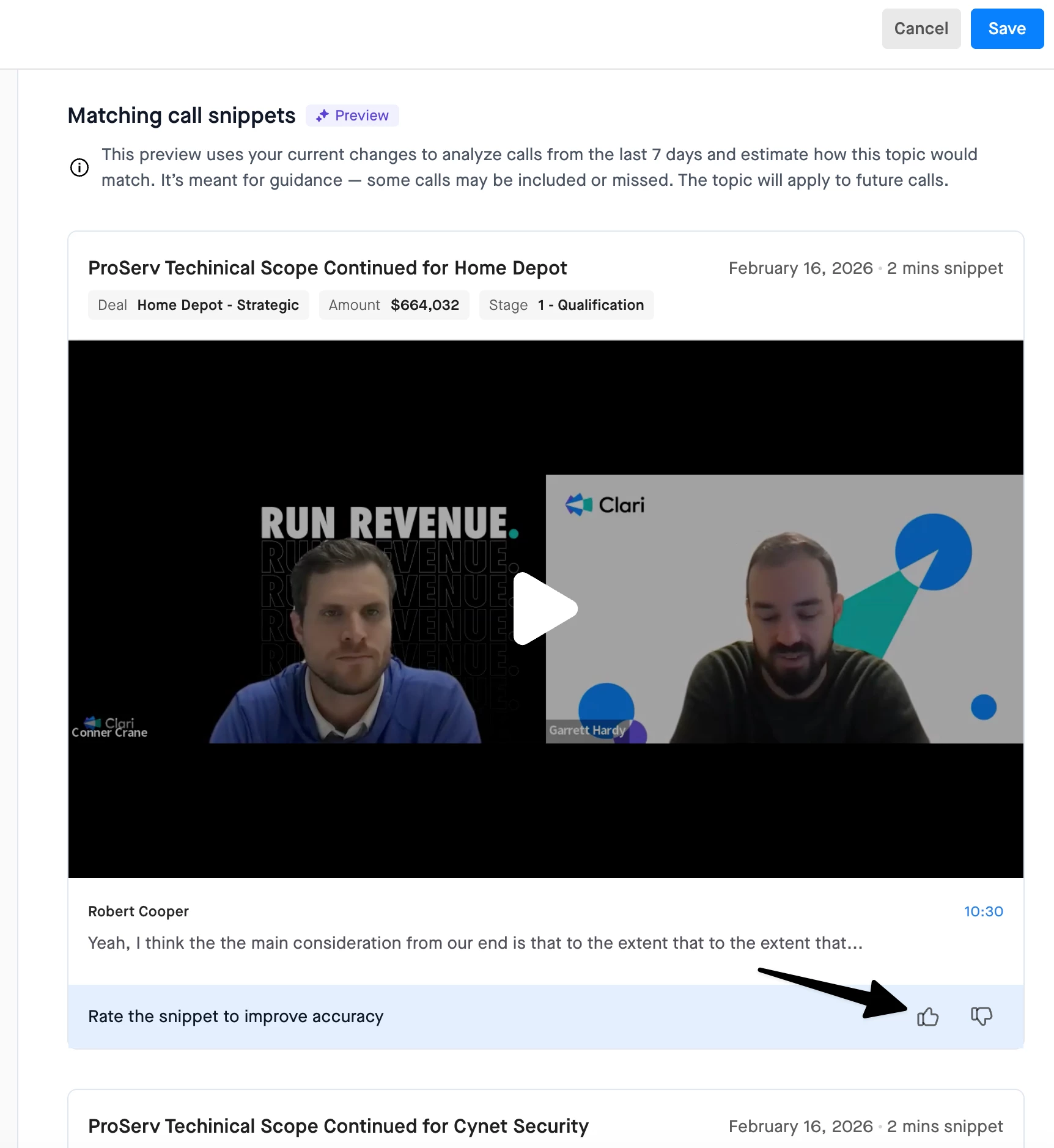
Examples help the system learn where the topic boundary lies.
| Guideline | Reason |
| 3+ positive examples | Improves pattern learning |
| Negative examples | Defines boundaries |
| Diverse phrasing | Covers different speaking styles |
| Edge cases | Teaches subtle distinctions |
Example: AI Interviewer Topic
Positive exampler:
“Our AI interviewer conducts the initial candidate screening automatically.”
Negative exampler:
“We have a team focused on the AI interviewer product.”
The negative example teaches the system that casual mentions should not trigger the topic.
Negative examples are especially important for ambiguous topics because they help define where the topic should stop matching.
Common Pitfalls
| Pitfall | Example | Fix |
| Too generic | “Discussion about food packages” | Describe the scenario or pricing structure |
| Single keyword topic | “Rep says pulse” | Add context and behavior |
| Missing exclusions | “Anything related to FedRamp” | Exclude passing mentions |
| Too many keywords | “AI, LLM, ChatGPT…” | Focus on a specific behavior |
| No negative examples | Ambiguous topic with only positives | Add near-miss examples |
Pre-Submission Checklist
Before saving a new Smart Topic, confirm the following:
✓ Scenario clearly described
✓ Behavioral signals defined
✓ Exclusions listed
✓ Keywords included
✓ Structured description used
✓ At least three positive exemplars selected
✓ Negative examples added if needed
Summary
The difference between strong and weak topics usually comes down to three factors.
- High-performing topics use behavior-first descriptions, clear exclusions, supporting keywords, and strong examples.
- Low-performing topics rely on vague definitions, keyword-only descriptions, missing exclusions, and no examples.
- When a topic clearly defines the interaction happening in the conversation, detection accuracy improves significantly.
Smart Topics help teams surface insights from conversations, whether tracking competitors, deal progress, customer risk, or coaching opportunities across the sales organization.